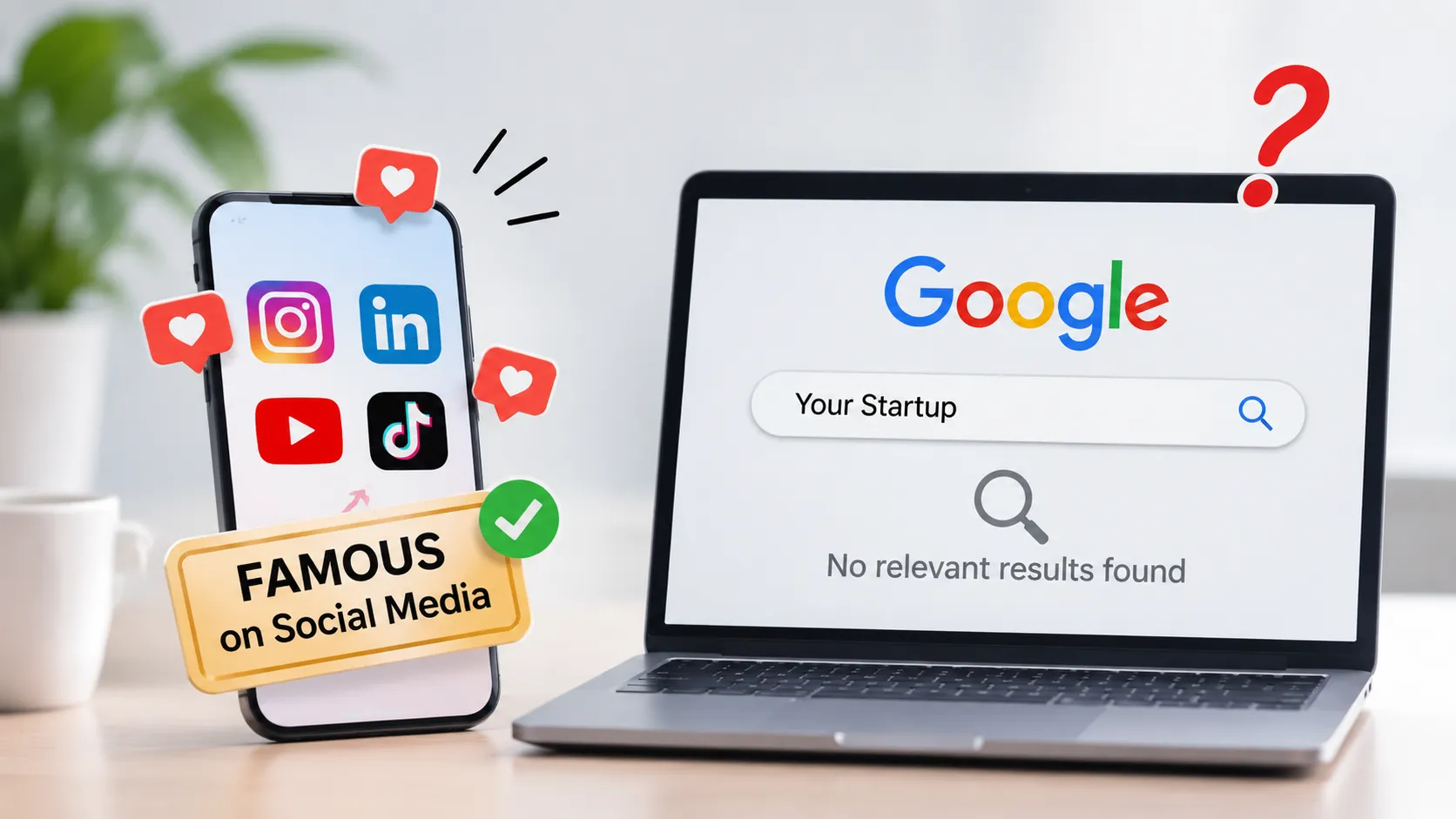
Your startup has appeared on Shark Tank, your founder is getting podcast invitations, influencers are promoting your products, and your Instagram following is growing. But when potential customers search Google for products like yours, your competitors are getting noticed instead. Why?
Let's be honest. Getting 100K Instagram followers is not easy. Getting featured on a popular business podcast is not easy either. And if your startup has appeared on Shark Tank India, you have already achieved something many founders dream about.
But here is a question that deserves more attention:
If your startup is getting so much attention on social media, why are people still finding your competitors on Google instead of you?
Imagine a customer watching your founder's interview on YouTube. They become interested in your product. Instead of purchasing immediately, they search Google to compare prices, read reviews, check alternatives and understand whether your product is worth buying.
Your brand is nowhere on the first page.
Instead, they find three competitors, two comparison websites and a marketplace selling similar products.
The customer may never return to your Instagram profile.
This is a marketing gap that many growing startups overlook.
They spend heavily on social media, influencer marketing, PR and brand awareness but often treat SEO as something they can worry about later.
At Codioo, we believe this is the wrong way to look at organic search. Our team has experience working with startups, including brands featured on Shark Tank. One important lesson from the startup growth environment is that brand recognition and search visibility need to be developed together.
A business can be popular without being easy to discover through search.
And that is exactly what we are going to discuss.
Why Do Startups With Strong Social Media Presence Still Struggle With SEO?
The simple answer is that social media visibility and Google search visibility are different things.
Social media helps people discover your brand while they are scrolling, watching videos or following creators. Google helps people discover information when they actively search for a product, service, brand or solution.
Having a large social media following does not automatically mean your website has relevant pages, strong search visibility or enough information to compete for non-branded keywords.
Consider this example:
Imagine a D2C startup with:
-
150,000 Instagram followers.
-
Regular influencer collaborations.
-
Several viral product videos.
-
A founder featured on popular podcasts.
-
Media coverage across business publications.
-
A growing customer community.
Now consider someone searching Google for the best products in that startup's category.
If the startup has only a homepage and a few basic product pages, while competitors have detailed category pages, comparison guides, customer resources and product information, the competitors may have a stronger opportunity to appear.
The startup has attention, but its website is not prepared to capture search demand.
This is why founders should stop treating social media popularity as proof of SEO performance.
Social media creates awareness. SEO helps your business become discoverable when customers actively search.
Neither replaces the other.
1. Your Startup Has Gone Viral, But You Are Not Capturing the Searches That Follow
This is one of the most interesting opportunities for startups.
Imagine your founder publishes a video explaining why traditional skincare products do not work for certain skin types.
The video gets 500,000 views.
People comment, share their experiences and ask questions about ingredients, product alternatives and skincare routines.
Now think about what happens after the video.
Some people visit your Instagram profile. Some follow your founder. But others open Google and start researching the subject.
They search for:
-
Best skincare products for oily skin.
-
How to choose a vitamin C serum.
-
Affordable skincare products for beginners.
-
Skincare ingredients to avoid for sensitive skin.
If your startup does not have useful content around these topics, other websites may capture that search demand.
Your viral video created interest, but your website did not convert that interest into organic discovery.
What we would do differently
Instead of simply publishing another blog based on a keyword tool, we would start with the questions people are already asking.
Here is a practical process:
Step 1: Review your social media comments.
Find repeated questions under your most popular posts.
Step 2: Identify the actual search intent.
Check whether people are looking for information, comparisons, product recommendations or solutions.
Step 3: Validate the search opportunity.
Use Google Search Console, Google search suggestions and keyword research tools to understand whether the topic has relevant search demand.
Step 4: Build useful website content.
Create an article, product guide or comparison page that answers the question properly.
Step 5: Connect the content to your products.
If relevant, guide visitors towards the product or service that solves their problem.
The objective is not to turn every Instagram comment into a blog post.
It is to identify conversations that reveal genuine customer demand.
A useful idea: Your social media audience can become one of your best sources of SEO research. You already have access to real customer questions. Start using them.
2. Your Founder Is Famous, But Your Brand Is Still Difficult to Understand on Google
Here is something that often gets overlooked.
A startup founder may have a strong personal brand. People recognise their face, follow their interviews and know their business journey.
But what happens when someone searches for the company?
Google may show a social media profile, a podcast, a news article, a marketplace listing and several third-party references.
Your official website may have very little useful information about the founder, company or product.
This creates an opportunity to improve how your business is presented online.
Build a recognisable digital identity for your startup
Your website should clearly explain:
-
What your company does.
-
Who founded it.
-
What products or services it offers.
-
Which customers it serves.
-
What problem it solves.
-
What makes the business different.
Consider a startup selling sustainable fashion.
Its homepage should not simply say:
"Changing the future of fashion."
That sounds attractive, but it does not explain much.
A more useful description would be:
"We create everyday clothing using responsibly sourced materials for customers looking for more sustainable fashion choices."
Now visitors understand the business.
Pages that help explain your brand
| Website page | Information to include |
|---|---|
| About Us | Company background and business purpose |
| Founder page | Founder experience and business journey |
| Product pages | Features, materials, pricing and benefits |
| Press and media | Genuine interviews and media coverage |
| Customer stories | Authentic experiences and reviews |
| Contact page | Business details and ways to connect |
You should also maintain consistent company information across your website and relevant external profiles.
Where appropriate, implement Organization structured data to help search engines understand your organisation.
Remember, structured data does not guarantee higher rankings. Its purpose is to provide accurate, machine-readable information about the business.
The bigger lesson: A strong founder brand is valuable, but your company should not depend entirely on your founder's social media profile to explain what the business does.
3. You Have Been Featured on Shark Tank or Popular Podcasts. Are You Making That Coverage Work Beyond Social Media?
Getting featured on Shark Tank India or appearing on a popular business podcast is a major opportunity.
But many brands use that attention only for social media promotion.
They publish a Reel, share a few photographs and post a thank-you message.
Then the opportunity slowly disappears from the marketing calendar.
What if you approached media coverage differently?
Turn media attention into searchable brand assets
Suppose your founder appears on a business podcast discussing how the company started, the problem it solves and the challenges faced while building the product.
Instead of only embedding the podcast video on your homepage, create a useful article around the discussion.
For example:
"How We Built a Sustainable Fashion Brand: Lessons From Our Founder's Journey"
The article could include:
-
The problem that inspired the startup.
-
The founder's original business idea.
-
How the company developed its products.
-
Challenges faced during growth.
-
Customer problems the business aims to solve.
-
Useful lessons for people interested in the industry.
You can also create a dedicated press page containing genuine media appearances and publications.
The digital PR opportunity
There is another important point.
When a relevant publication features your startup, check whether the article includes a link to your website.
A relevant editorial link can help people discover your business and contribute to your website's authority signals.
But remember:
-
A podcast appearance is not automatically a backlink.
-
A social media mention is not necessarily an editorial link.
-
A Shark Tank appearance does not guarantee rankings.
-
A large number of irrelevant links does not make your website authoritative.
The focus should be on earning relevant coverage and building a consistent digital identity.
Think beyond getting featured. Think about what happens to your brand's digital footprint after the feature.
4. Your Competitors Are Ranking for Keywords Your Social Media Audience Is Already Searching
This is where things become commercially interesting.
Let's take a hypothetical example of a startup selling premium protein snacks.
The company has a strong Instagram presence. Fitness influencers regularly feature its products, and its founder publishes educational videos.
But the website mainly targets its brand name and product names.
Meanwhile, competitors are ranking for:
-
Best protein snacks in India.
-
High-protein snacks for beginners.
-
Healthy snacks for office workers.
-
Protein bar comparison.
-
Best alternatives to conventional snacks.
These are non-branded searches.
The people searching for them may not know your company exists.
That means your startup is missing opportunities to reach customers before they choose a brand.
Build a non-branded keyword strategy
I would divide your search opportunities into four groups.
| Search category | Example | Recommended content |
|---|---|---|
| Brand searches | Startup name | Homepage |
| Product searches | Product name | Product page |
| Category searches | Best protein snacks in India | Category page or buying guide |
| Problem-based searches | Healthy snacks for office workers | Educational article |
The biggest mistake is concentrating only on branded searches.
If people already know your company name, they may find you easily. The real growth opportunity is reaching people who have not discovered your business yet.
How to identify the keyword gap
Take five important product-related searches and compare your website with competitors.
Check:
-
Which websites appear on the first page?
-
Are the results product pages, category pages or articles?
-
What questions do the ranking pages answer?
-
What information is missing?
-
Can your business provide a more useful answer?
Do not create another generic article just because a competitor has one.
Find a genuine information gap and fill it with something useful.
5. Your Instagram Bio Is More Informative Than Your Website Homepage
This might sound strange, but take a look at your startup's Instagram profile.
Does it explain your business clearly?
Does it tell visitors what you sell, who your products are for and where they can buy them?
Now open your website homepage.
Can a first-time visitor understand the same information within a few seconds?
Many startup websites have beautiful designs but unclear messaging.
There is a large hero image, a creative tagline, product photographs and a few animations.
But the visitor still has to scroll through the page to understand what the company actually offers.
This is not only a design issue. It is also a communication problem.
Your homepage should answer five questions
What do you sell?
Explain your main product or service.
Who is it for?
Identify your target audience.
What problem do you solve?
Tell customers why they should care.
Why should they trust you?
Show genuine product information, customer feedback, company details and relevant evidence.
What should they do next?
Provide a clear purchase, enquiry or booking option.
An example
Weak homepage message:
"Reimagining the future of everyday living."
Better homepage message:
"Smart home cleaning products designed to make everyday household cleaning easier."
The second statement communicates the offering more clearly.
You can still use creative branding. But make sure the main business information is easy to understand.
For D2C startups, product pages also deserve serious attention.
For SaaS startups, focus on product features, use cases, integrations, pricing and demonstrations.
Your website should answer the questions that social media posts cannot fully explain.
6. Stop Treating Your Blog as a Content Calendar. Treat It as a Customer Research Asset.
Many startups publish blogs because someone has decided that the website needs two or four articles every month.
The result?
Generic content that competitors have already published.
Instead of starting with a keyword list, start with customer conversations.
Your startup already has access to useful information:
-
Customer support questions.
-
Instagram comments.
-
Founder interviews.
-
Sales calls.
-
Product reviews.
-
Influencer feedback.
-
Community discussions.
These are valuable sources of content ideas.
Turn customer conversations into searchable resources
Imagine a SaaS startup that sells inventory management software.
Its sales team repeatedly receives questions such as:
-
How can small businesses manage stock?
-
How do I track inventory across multiple stores?
-
Can inventory software integrate with accounting tools?
-
How much does inventory management software cost?
Instead of asking a writer to create generic articles about inventory management, the marketing team can use these questions to build specific resources.
For example:
Article 1: How to Manage Inventory Across Multiple Store Locations.
Article 2: Inventory Management Software vs Excel: Which Is Better for Small Businesses?
Article 3: What Should You Check Before Buying Inventory Management Software?
These articles are more closely connected to actual customer requirements.
A content research method we recommend
| Source | What to look for |
|---|---|
| Sales calls | Questions that delay purchase decisions |
| Customer support | Problems customers repeatedly face |
| Instagram comments | Product questions and objections |
| Reviews | What customers appreciate or dislike |
| Founder interviews | Industry insights and original opinions |
| Competitor reviews | Unanswered customer concerns |
The key is to publish content that helps customers make decisions.
Do not just rewrite existing articles. Include original explanations, examples, product knowledge and genuine experience.
A blog should not exist only to bring visitors. It should help the right visitors understand why your product matters.
7. Your Startup Is Getting Traffic, But Are You Getting Customers?
Here is a situation that deserves more attention than another keyword report.
A startup's website receives 20,000 organic visits every month.
The founder is happy because traffic is increasing.
But the sales team says something different. Enquiries are not increasing, and the number of actual customers remains almost unchanged.
What is happening?
The website may be attracting people who are interested in general information rather than people who are ready to consider the product.
Or visitors may not be finding enough information to trust the business.
This is why traffic alone should never be the final measure of SEO success.
Look at the entire customer journey
Imagine someone searching for a product comparison.
They land on your article, read about different options and visit your product page.
But the product page does not explain pricing, delivery, features or customer experiences.
The visitor leaves.
In this case, publishing another article may not solve the problem.
The existing customer journey needs attention.
What I would investigate
-
Which landing pages receive organic visits?
-
Which pages generate enquiries?
-
Are important product details missing?
-
Are pricing and purchasing information clear?
-
Are customer reviews genuine and visible?
-
Is the next step easy to understand?
-
Are enquiry forms working correctly?
-
Does the website work properly on mobile devices?
You can use Google Analytics 4, Google Search Console and CRM data to understand what happens after someone arrives.
For startups, this connection between SEO and revenue is particularly important.
A page with fewer visitors but more qualified enquiries may be more valuable than a high-traffic article that does not support the business.
Do not just ask how much traffic SEO generated. Ask how much useful business that traffic created.
8. Your Next Growth Opportunity May Be Hidden in Branded Search Data
This is one of the more interesting things founders should monitor after receiving significant media or social media attention.
Suppose your startup gets featured on a popular podcast.
Over the next few weeks, more people begin searching for the company name.
But what happens after those people arrive on Google?
They may search for:
-
Your startup name.
-
Your startup name reviews.
-
Your startup name founder.
-
Your startup name products.
-
Your startup name pricing.
-
Your startup name alternatives.
These searches reveal what people want to know before trusting or purchasing from your business.
Use branded search queries to understand customer interest
Open Google Search Console and review the Performance report.
Filter queries containing your brand name.
Look at:
-
Which branded queries receive impressions?
-
Which queries generate clicks?
-
Are people looking for reviews?
-
Are people searching for particular products?
-
Are they looking for the founder or company background?
-
Are competitors appearing for branded searches?
Now look for missing information on your website.
If people search for your company reviews but you have no useful customer feedback page, you have identified an opportunity.
If they search for pricing but the website provides no pricing guidance, consider whether you can make the buying process clearer.
If they search for a specific product but land on the homepage, improve the product discovery journey.
This is a different way of using keyword research.
Instead of only asking what people search before discovering your business, investigate what they search after becoming interested in it.
That information can help improve both SEO and conversion experience.
9. Build an SEO Strategy That Works Even When Your Next Instagram Reel Doesn't Go Viral
Social media reach can change quickly.
A post may receive hundreds of thousands of views one week and considerably fewer the next.
A platform can change its algorithm. An influencer campaign may finish. A paid promotion may stop generating traffic when the budget ends.
This does not mean social media is unreliable or unimportant.
It means a business should avoid depending on a single source of discovery.
SEO can become another acquisition channel when you build useful pages that continue to serve customer needs.
What should your startup build?
| Asset | Why it matters |
|---|---|
| Homepage | Explains your brand and offering |
| Product pages | Helps customers understand what you sell |
| Category pages | Targets broader product-related searches |
| Comparison guides | Helps people evaluate different options |
| Educational resources | Answers customer questions |
| Founder and company pages | Provides business context |
| Genuine customer stories | Demonstrates real customer experiences |
| Media page | Organises relevant brand coverage |
You do not need to create all these pages on day one.
Start with the pages that support your most important business objectives.
The aim is to build a website that becomes more useful as your startup grows.
A Practical 90-Day SEO Plan for Startups With Strong Social Media Presence
If your startup already has an active social media community, I would approach SEO differently from a completely new business.
You already have customer conversations, product feedback, brand recognition and potentially useful media coverage.
Use those assets.
Days 1–30: Find out where your startup is missing from Google
Focus on understanding the existing search visibility.
-
Connect and review Google Search Console.
-
Identify branded and non-branded search queries.
-
Check the indexing status of important pages.
-
Analyse five direct competitors.
-
Compare your product and category pages.
-
Review your homepage messaging.
-
Identify questions repeatedly asked on social media.
-
Check which media publications mention your brand.
Expected output: A search visibility gap report showing what your website currently ranks for, what competitors rank for and which pages need attention.
Days 31–60: Turn brand recognition into useful website assets
Now start improving the website.
-
Rewrite unclear homepage messaging.
-
Improve important product and service pages.
-
Build relevant category landing pages.
-
Create content around genuine customer questions.
-
Publish useful founder and company information.
-
Organise genuine press coverage.
-
Add relevant internal links.
-
Improve mobile usability and technical SEO.
Expected output: A more complete website with useful pages for brand, product and category searches.
Days 61–90: Measure the impact and identify the next opportunities
Now investigate the performance.
-
Compare branded and non-branded impressions.
-
Check organic clicks and landing pages.
-
Monitor important keyword groups.
-
Identify pages receiving impressions but few clicks.
-
Review organic enquiries and purchases.
-
Improve pages that attract traffic but do not convert.
-
Identify additional content opportunities from customer feedback.
Expected output: A measurable SEO improvement plan based on actual search and business data.
These are implementation milestones, not guaranteed ranking or traffic targets. SEO results depend on competition, website history, demand and execution.
How Should Startup Founders Measure SEO Success?
If you are already spending money on social media, influencers and PR, your SEO reporting should go beyond keyword rankings.
I would monitor these metrics:
| SEO metric | Why founders should care |
|---|---|
| Branded impressions | Shows how often your brand appears in relevant Google searches |
| Non-branded impressions | Shows opportunities to reach people who do not know your brand |
| Organic clicks | Measures visits from Google Search |
| Product page traffic | Shows whether customers discover specific offerings |
| Qualified organic leads | Connects search activity with business opportunities |
| Organic revenue | Measures sales attributed to organic search where tracking permits |
| Referring domains | Helps understand relevant external website references |
One metric I particularly recommend is the ratio of branded to non-branded search visibility.
A startup may receive significant branded traffic because of influencer campaigns and media exposure.
But if it is not appearing for relevant non-branded searches, it may still have a major acquisition gap.
Monitor both.
Also, do not automatically attribute an increase in branded searches to SEO. Social media, paid campaigns, offline activity and PR can all contribute.
Good reporting should help you understand where growth is coming from, not simply take credit for it.
What About AEO and AI Search? Will Startups Need More Than Traditional SEO?
Yes, startup founders should pay attention to how people discover information through AI-powered search experiences.
Customers are increasingly using conversational queries to research products, compare businesses and understand different solutions.
For example, instead of searching only for "best inventory software", someone might ask:
"Which inventory management software is suitable for a small retail business with three outlets?"
This creates an opportunity for startups to publish clearer, more useful answers.
How to make your startup content AEO-friendly
1. Answer questions directly.
Use headings that reflect actual customer questions and provide a clear answer immediately below them.
2. Explain your products properly.
Avoid vague marketing language. Clearly describe features, use cases, limitations and benefits.
3. Publish original information.
Include genuine product demonstrations, customer examples, research, founder insights and practical observations.
4. Use structured content.
Organise articles with meaningful headings, short paragraphs, lists and comparison tables.
5. Build trust.
Provide transparent company information, accurate authorship, genuine reviews and credible references.
6. Maintain technical accessibility.
Make sure important website pages can be crawled and indexed.
SEO, AEO and GEO: What is the difference?
| Term | Main focus |
|---|---|
| SEO | Improving visibility in traditional search engines |
| AEO | Making useful information easier to discover and present as answers |
| GEO | Improving discoverability and representation in generative AI search experiences |
These approaches overlap considerably. They are not three separate marketing systems that require completely different content strategies.
Google's guidance for AI search experiences continues to emphasise useful, original content and strong technical foundations. There is no guaranteed shortcut to getting your startup mentioned by an AI tool.
The smartest approach is to create information that genuinely deserves to be discovered, referenced and used.
Final Thoughts: You Have Built the Brand. Now Make Sure People Can Find It.
Getting featured on Shark Tank, building an Instagram community, working with influencers or appearing on popular podcasts is a big achievement.
It takes considerable effort to make people recognise and remember a brand.
But brand recognition should not be the end of your digital growth strategy.
Think about how customers behave.
They may discover your company on Instagram, watch your founder's interview on YouTube, hear about your product from a friend and finally search Google before making a purchase.
If your website is not visible during that research process, you are leaving an important part of customer discovery to your competitors.
You do not need to choose between social media and SEO.
Keep building your social media presence. Continue investing in PR and brand awareness. But make sure your website is equally prepared to answer the questions people ask when they search.
Because being popular on Instagram is great.
Being discoverable when someone is ready to buy is even better.
You have already earned the attention. Now build the search visibility to make that attention work harder for your business.
Frequently Asked Questions
1. Why do startups with thousands of Instagram followers still struggle to rank on Google?
Instagram followers do not directly determine Google rankings. A startup may have strong social media engagement but lack relevant website content, technical SEO, non-branded keyword targeting and useful product information. Social media popularity and organic search visibility are separate aspects of digital marketing.
2. Does appearing on Shark Tank India improve Google rankings?
Appearing on Shark Tank India does not automatically improve Google rankings. However, the exposure can generate branded searches, media coverage, website visits and opportunities for relevant editorial links. Startups should use that attention to build useful, discoverable information about their brand.
3. How can a startup convert social media followers into organic website traffic?
Start by analysing popular posts, customer comments and frequently asked questions. Identify topics with genuine search demand, create useful website resources around them and link those resources to relevant product or service pages. Social media can help introduce the topic, while SEO can help people discover it through search.
4. What is the difference between branded and non-branded SEO?
Branded SEO targets searches containing your company or product name. Non-branded SEO targets searches related to your product category, industry or customer problems without mentioning your brand. Both are important for startup growth.
5. How can a startup improve its visibility on Google without publishing hundreds of blogs?
Improve existing product pages, build useful category pages, answer specific customer questions, organise genuine media coverage and strengthen relevant internal linking. A smaller number of genuinely useful pages can be more valuable than hundreds of repetitive articles.
6. Can influencer marketing help SEO?
Influencer marketing can indirectly support SEO by increasing brand awareness, generating branded searches, creating discussions and attracting relevant editorial coverage. However, social media engagement and influencer mentions do not automatically create backlinks or improve rankings.
7. What type of content should a Shark Tank startup publish for SEO?
It depends on the product and customer. Useful options include product comparisons, category guides, educational resources, founder stories, product demonstrations, customer case studies and answers to common buying questions. Content should address actual customer needs rather than simply promote the company's appearance on the show.
8. How long does it take for a startup to improve organic search visibility?
There is no fixed timeline. Some indexing and technical improvements may become visible relatively quickly, while competitive rankings can take several months or longer. Results depend on the website's starting condition, competition, content quality and market demand.
9. What should startup founders track in Google Search Console?
Founders should monitor branded and non-branded queries, impressions, clicks, click-through rate, average position and landing-page performance. These metrics help identify whether the website is reaching people who already know the brand and people discovering it for the first time.
10. Does a startup need SEO if it already gets customers from Instagram?
Yes, if potential customers use Google to research products, compare options or find businesses in the startup's category. SEO provides another discovery channel and can reduce dependence on a single marketing platform. However, the investment should be based on actual customer search behaviour and business economics.
11. What is AEO and why should startup founders care about it?
Answer Engine Optimization (AEO) refers to making content easier for answer-focused search systems to discover and present. Startups can support answer visibility by publishing clear answers, useful explanations, original information and trustworthy business details. AEO does not guarantee inclusion in AI-generated answers.
12. Should a startup hire an SEO agency or build an in-house team?
It depends on the startup's budget, internal expertise and growth requirements. An in-house team offers closer integration with the product and marketing teams, while an agency can provide specialised SEO skills without requiring every role to be hired internally. Evaluate the costs, deliverables and business outcomes before deciding.
For more guidance, read our SEO guide for startups.
About the Author
Codioo Team
Codioo is a digital strategy and technology team based in Jaipur, India, working with businesses and startups on digital growth, website development and online visibility.
Our team brings experience from working with startups, including brands featured on Shark Tank. We believe sustainable digital growth requires more than social media attention: it requires a useful website, a clear brand identity and a search strategy built around real customer needs.