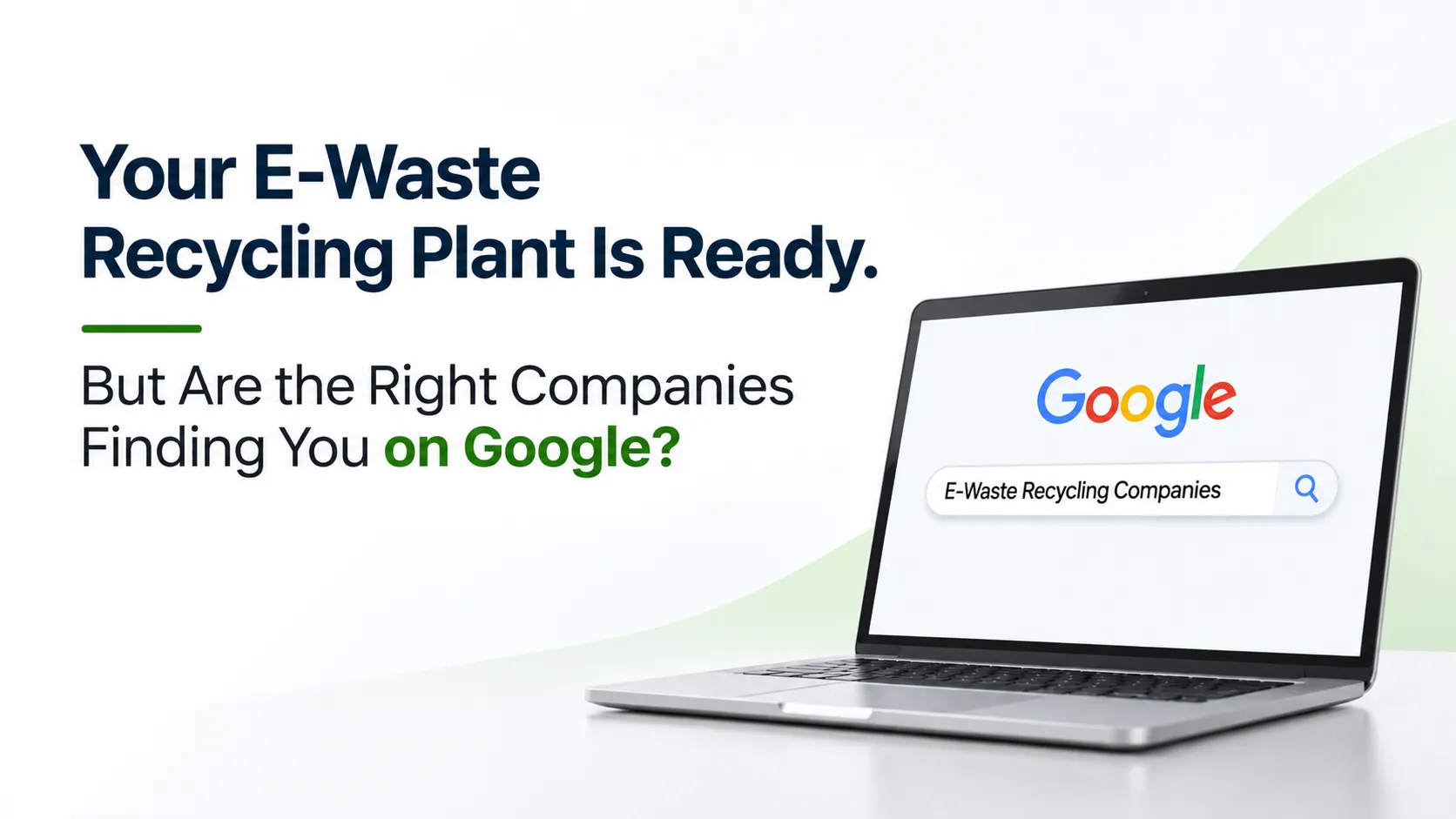
A factory owner needs an e-waste recycling partner. Your facility can handle the requirement. But the enquiry goes to another company.
You have spent years building your recycling business.
You invested in machinery. You found a suitable industrial location. You hired operators, arranged transportation and built relationships with scrap suppliers.
Perhaps you have an e-waste processing facility. Perhaps you recycle plastic, recover metals, process used batteries or manufacture recycled raw materials.
You know your business can handle serious volumes.
But there is one question worth asking.
How many new businesses discovered your company through Google last month?
Not existing customers. Not referrals. Not people who already had your phone number.
How many manufacturers, electronics companies, corporate IT managers, procurement teams or overseas buyers found you because they were searching for a recycling partner?
For many recycling founders, the answer is surprisingly small.
And that is an expensive problem.
Imagine having machinery capable of processing 1,000 tonnes of material but struggling to maintain a consistent supply of waste. Or producing recycled material but spending weeks trying to find new buyers.
Your operational capacity is not necessarily the problem.
Your visibility might be.
A manufacturer in Pune may be searching for an e-waste recycling company. A packaging business in Gujarat may need a PET recycling partner. An electronics company in Germany may be looking for recycled materials. A warehouse operator in the UK may need a commercial waste management provider.
They are already searching.
But are they finding your business?
This is where SEO deserves a different kind of attention from recycling industry founders.
Not as another marketing expense. Not as a plan to publish hundreds of generic blogs.
As a way to put your actual recycling capabilities in front of businesses that need them.
A story that many e-waste founders will recognise
Imagine you run an electronic waste recycling company in India.
Your facility handles computers, laptops, servers, circuit boards and other electronic equipment. You have invested in the infrastructure and developed the processes needed to manage corporate e-waste.
You want more contracts.
One morning, a large company decides to replace its old IT equipment.
It has 600 laptops, 80 servers and several hundred networking devices spread across three offices.
The IT department is responsible for clearing the equipment. But the company has concerns beyond simply removing the devices.
It wants to know:
-
Who will collect the equipment?
-
Can the company manage all three locations?
-
How will the devices be inventoried?
-
What happens to the data stored on old hard drives?
-
Will the recycler provide the required handover records?
-
Where will the electronic waste be processed?
The IT manager searches Google for a corporate e-waste recycling partner.
Three companies appear.
One has a dedicated page explaining corporate IT asset disposal, data destruction, collection and recycling.
Another has a website saying, "We are one of the best e-waste recycling companies."
The third has a basic homepage with a contact number.
The first company has already answered several questions before receiving the call.
It has made the buying decision easier.
Now, imagine that your recycling facility is actually more capable than the first company, but your website is the second or third one.
The buyer cannot evaluate your machinery, your team or your experience because none of it is properly explained online.
You may never even know that the opportunity existed.
This is the gap SEO needs to solve for recycling businesses: the gap between what a company can do and what potential customers can discover about it.
Look at what successful recycling businesses are doing differently
There is a useful lesson in how established recycling businesses present themselves.
Take India's Eco Recycling Limited (Ecoreco).
Its website does not simply say that it recycles electronic waste. It presents several distinct services, including EPR compliance, IT asset disposition, data destruction, reverse logistics, WEEE recycling and battery recycling.
Its About page also describes its corporate customer base, facility capabilities and operational model.
Think about what this means from a search perspective.
A corporate buyer looking for IT asset disposition has a relevant service to explore.
A company concerned about data destruction can find information about that service.
An organisation looking for e-waste collection and processing can explore its broader recycling capabilities.
The company has made it easier for different audiences to understand what it offers.
This is an important lesson for smaller recycling founders.
You do not need the same scale as an established company to use the same principle.
If you offer corporate e-waste collection, explain it.
If you handle lithium-ion battery recycling, explain it.
If you supply recycled plastic granules, show the specifications.
If you buy industrial metal scrap, tell potential suppliers what materials you accept.
Do not hide multiple commercial services behind one generic page called "Our Services".
Your website should reflect the actual business you are building.
Your recycling plant needs two types of customers. Does your website speak to both?
Here is something many recycling founders overlook.
A recycling company is not always selling to one type of customer.
It may need businesses that supply recyclable material.
It may also need businesses that purchase the recovered output.
Consider a plastic recycling company.
On one side, it wants manufacturers, warehouses and packaging companies to supply plastic waste.
On the other side, it wants manufacturers to purchase recycled plastic flakes or granules.
These are two different commercial relationships.
Now consider an e-waste recycler.
It may need corporate offices, banks, IT companies and electronics manufacturers to supply old equipment.
Depending on its business model and recovery capabilities, it may also sell recovered materials or work with downstream processors.
If the website speaks only to people looking to dispose of waste, it may miss the other side of the business.
Think about the searches.
A factory manager may search for a plastic scrap buyer.
A packaging manufacturer may search for a recycled PET flakes supplier.
An IT administrator may search for a bulk laptop disposal service.
A corporate procurement manager may search for an authorised e-waste recycler.
A metal manufacturer may search for an aluminium scrap supplier.
Each search represents a different commercial requirement.
A founder should ask:
Does my website help both the businesses that supply my material and the businesses that buy my output?
If not, there may be an opportunity to build separate, useful pages for each audience.
The e-waste opportunity: Why being visible to corporate buyers matters
Electronic waste is a particularly interesting example because the buyer's decision is rarely based on price alone.
Think about a bank replacing hundreds of computers.
It is not simply looking for someone to take away old equipment.
It may need asset inventory, secure data handling, collection coordination and documented processing.
A hospital replacing electronic equipment may have different requirements.
An IT company clearing servers may be concerned about data destruction.
An electronics manufacturer may need an ongoing e-waste management arrangement.
The same recycler may be capable of serving several of these businesses, but each customer has a different reason for searching.
This gives e-waste companies an opportunity to build content around actual commercial requirements.
For example:
Corporate IT asset disposal
A page explaining how your company handles retired laptops, desktops, servers and other IT assets.
Bulk laptop recycling
A page aimed at businesses replacing large quantities of equipment.
Secure data destruction
A page explaining the actual data sanitisation or physical destruction services offered.
E-waste collection for manufacturers
A page explaining collection, logistics, processing and documentation for industrial customers.
E-waste recycling for educational institutions
A page for schools, colleges and universities replacing computer laboratory equipment.
These pages are not just keyword targets.
They help a potential customer understand whether your company can handle its requirement.
The same approach works for battery recyclers, plastic processors, metal recyclers and industrial waste companies.
An Indian recycling founder should not think only about the Indian market
Let's say you manufacture recycled plastic granules in India.
You already have domestic buyers, but you want to expand your customer base.
You start attending trade exhibitions. You contact manufacturers. You speak with potential importers.
But what happens when a buyer in the UAE, UK or Europe searches online for a recycled material supplier?
Will they understand your product specifications?
Can they see the grades you supply?
Do you explain your available quantities?
Can they find information about your export capabilities?
Is there an easy way to contact your international sales team?
If the answer is no, your website is not doing enough to support your international business development.
International SEO is not about adding the words "USA", "UK" and "Europe" to every page.
It is about understanding what buyers in those markets need to know.
For example, an overseas buyer may want:
-
Material grade and specifications.
-
Product applications.
-
Available monthly quantity.
-
Quality documentation.
-
Packaging information.
-
Shipping arrangements.
-
Export capability.
-
Commercial enquiry details.
A product page that answers these questions is much more useful than a generic page about sustainability.
The same applies in the opposite direction.
A UK recycling equipment manufacturer may want to sell machinery to Indian recycling plants. A European metal recycling company may want to reach buyers in multiple countries. A US electronics recycling business may want to attract commercial customers in different states.
SEO can help these companies become discoverable beyond their existing networks.
Of course, international marketing must reflect actual service and export capabilities. Waste shipment and import/export regulations must be checked separately.
What real SEO case studies tell recycling founders
It is easy to say that SEO can help a recycling company grow.
But there are published examples from the sector that make the commercial opportunity more concrete.
Example 1: A metal recycling company building visibility across international markets
RMC Polska, a recycling business in Poland, had very little organic search visibility when its SEO project began.
The challenge was not simply getting more visitors. The company wanted to attract businesses searching for scrap metal buying services and expand visibility beyond its domestic market.
The published case study describes an SEO strategy focused on commercial keywords and international visibility across Germany, France, the USA and India.
The agency reports that organic search accounted for 80.1% of traffic and that 133 keywords reached the top three positions.
The lesson for an Indian recycling founder is not to copy those numbers.
It is to recognise that a recycling business can use SEO to reach companies in markets where it has not traditionally depended on personal relationships.
Example 2: An electronics recycling business in the United States
Techbros Electronic Recycling faced a problem familiar to many specialist recycling companies.
It offered electronics recycling and IT asset disposition services, but its online presence was not bringing enough attention to its capabilities.
The published case study describes a strategy involving technical SEO, local content and website improvements.
The agency reports a 3,300% increase in organic traffic and substantial growth in ranking keywords and clicks over the reported campaign period.
The interesting part is the business model.
The company was not trying to attract everyone interested in recycling.
It wanted to reach people and businesses looking for electronic recycling and IT asset disposition services.
Example 3: A UK recycling equipment manufacturer
QCR Recycling Equipment offers recycling equipment for businesses.
Its SEO case study reports a 57% increase in organic traffic and a 78% increase in website leads after working with its marketing agency.
Why is this relevant to recycling founders?
Because the company sells equipment to businesses that have a practical requirement.
Someone searching for recycling machinery is not necessarily looking for general environmental information. They may be planning to buy equipment, improve a facility or reduce operating costs.
That is commercial search intent.
The common lesson across these examples is that industry-specific visibility matters more than simply generating large volumes of unrelated website traffic.
These are agency-published case studies, and their results are not independently verified or guaranteed to repeat for another business.
What if your competitor is winning enquiries simply because its website explains more?
Let's try another situation.
You operate an e-waste recycling facility in Gujarat.
A company in Maharashtra needs a recycler for its old computers and electronic equipment.
It searches online and finds a competitor.
The competitor has pages covering:
-
Corporate e-waste recycling.
-
Bulk electronics collection.
-
Data destruction.
-
E-waste processing.
-
EPR-related services.
Your website has one page titled "E-Waste Recycling".
You offer several of the same services, but your website does not explain them.
The buyer contacts the competitor.
This is not necessarily a story about better machinery or lower pricing.
It may simply be a story about better communication.
This is why founders should review their websites from the customer's perspective.
Do not ask whether your website looks modern.
Ask whether a procurement manager can understand your services in two minutes.
Can a buyer see the materials you accept?
Can a company understand your collection coverage?
Can a manufacturer find your recycled product specifications?
Can someone request a bulk quotation without searching for your phone number?
A website should help your sales team, not create another obstacle for potential customers.
The biggest mistake: Treating recycling SEO like a normal blogging project
Many businesses start SEO by asking for 20 blog topics.
The agency prepares articles such as:
-
Importance of recycling.
-
Benefits of e-waste management.
-
Why plastic recycling matters.
-
How recycling protects the environment.
These subjects can be useful, but they are not enough.
Imagine that your company has just invested in a new battery recycling line.
You need businesses supplying end-of-life batteries.
Would you rather have an article attracting students searching for "why battery recycling is important", or a page that explains your actual battery collection and processing capabilities to industrial customers?
Both types of content have a role, but the commercial page should not be missing.
A recycling company's content strategy should begin with its business model.
If you are an e-waste recycler, create content around corporate IT disposal, collection and processing.
If you are a plastic recycler, explain material grades, contamination, recycled outputs and supply capabilities.
If you are a metal scrap buyer, explain accepted materials, collection locations and commercial purchasing arrangements.
If you manufacture recycling machinery, explain equipment capacity, applications, technical specifications and operating benefits.
Your industry knowledge is your content advantage.
A general writer may know what recycling means.
Your plant manager knows why a particular material is difficult to process.
Your founder knows which customers struggle with collection and logistics.
Your technical team understands the equipment.
Bring that knowledge onto the website.
How to make a recycling website generate better business enquiries
Consider two enquiry forms.
The first asks for a name, email address and phone number.
The second asks what material the customer has, its approximate quantity, location and required service.
Which one is more useful to a recycling sales team?
The second.
A recycling business often needs to understand the commercial requirement before it can even decide whether an enquiry is suitable.
For example, an e-waste recycler may want to know:
-
Is the enquiry for laptops, servers or mixed electronics?
-
Is it a one-time collection or a recurring requirement?
-
How many devices are involved?
-
Where are they located?
-
Is data destruction required?
-
Does the company need a particular document or process?
A plastic recycler may want to know the material grade, monthly quantity, contamination level and location.
A recycled material supplier may want to understand the required grade, specification and quantity.
These details can help your sales team respond more effectively.
SEO should not stop when someone lands on the website.
The journey should continue from search to enquiry, quotation and eventually a commercial relationship.
India, UK, Europe and the USA: Different markets, one important lesson
A recycling company targeting India may focus on city-specific collection, industrial customers and material suppliers.
A business in the UK may want commercial waste contracts from manufacturers and retailers.
A European recycler may target specialist material processing or industrial buyers.
A US electronics recycler may want to attract corporate IT disposal contracts across different locations.
The search terms and regulations differ, but the commercial question is similar:
Can the right business find you when it needs your service?
Here are examples of how the SEO approach can differ.
| Market | Possible business opportunity | Search intent |
|---|---|---|
| India | Corporate e-waste collection | Companies disposing of old IT equipment |
| India | Plastic scrap procurement | Manufacturers and warehouses supplying waste |
| UK | Commercial waste recycling | Businesses seeking a waste management provider |
| Germany | Industrial recycling services | Manufacturers seeking specialist processing |
| USA | IT asset disposition | Businesses replacing computers and servers |
| UAE | Industrial waste recycling | Companies seeking collection and processing |
| Australia | Commercial e-waste services | Businesses managing end-of-life electronics |
These are illustrative market opportunities, not verified keyword-demand figures. Actual demand, regulatory requirements and service feasibility should be researched before entering each market.
A simple 30-day exercise for a recycling founder
If you run a recycling business and are unsure where to start with SEO, try this.
Do not begin with a large marketing budget.
Start with one business problem.
Suppose you want more corporate e-waste contracts.
Open Google and search for the services your customers may need.
Look at the companies appearing on the first page.
Visit their websites.
Now ask yourself:
Does my website explain the same services?
Does it show my facility?
Does it explain the collection process?
Does it mention data security?
Does it show relevant registrations?
Does it make it easy to request a quotation?
Then choose the most important missing information and improve your website.
You can also ask your existing customers how they first found you and what they searched before contacting your company.
You may discover that customers do not search for "recycling solutions".
They search for "bulk laptop disposal", "industrial plastic scrap buyer" or "recycled PET granules supplier".
That information is worth more than a random list of keywords.
The founder's question should change
A recycling founder often asks:
"How do we get more traffic to our website?"
A better question is:
"Which businesses should be finding us online but currently are not?"
Maybe it is the manufacturer replacing its production equipment.
Maybe it is the bank disposing of thousands of old computers.
Maybe it is the packaging company looking for recycled plastic.
Maybe it is an overseas buyer searching for a reliable recycled material supplier.
Once you identify those businesses, your SEO strategy becomes much clearer.
You know which services need dedicated pages.
You know which questions deserve useful articles.
You know which locations matter.
You know what your website must communicate.
And you can measure whether the work is generating relevant commercial enquiries.
Final thought: Your recycling plant should be easier to find than your competitor's
You may have invested crores in machinery.
You may have built a facility that can process complex waste streams.
You may have a skilled team and years of industry experience.
But potential customers cannot choose your business if they do not know what you can do.
SEO gives recycling companies an opportunity to make their operational strengths visible.
It can help an e-waste recycler reach corporate IT managers, a plastic processor connect with manufacturers, a metal recycler attract industrial scrap suppliers and a recycled material producer reach buyers in new markets.
It does not guarantee contracts, and it cannot replace operational quality or sales relationships.
But it can make sure that when a potential customer starts searching, your business has a chance to be considered.
Your machinery creates the capacity. Your people create the value. Your website should help the right customers discover both.
About Codioo
Codioo helps businesses improve their digital visibility through SEO, website development and digital growth strategies. We focus on connecting businesses with the people and organisations actively searching for their services.