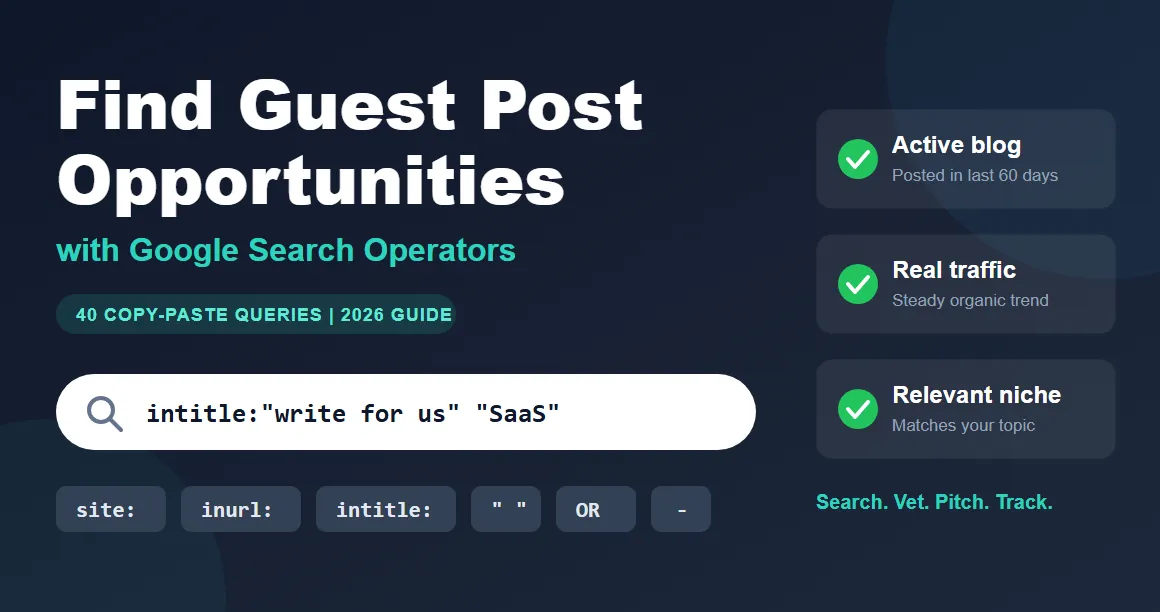
Quick Answer (TL;DR)
To find guest post opportunities with Google, combine your niche keyword with a submission phrase and an operator. The three most reliable formulas are:
"[niche]" intitle:"write for us""[niche]" inurl:write-for-us"[niche]" ("guest post" OR "contribute" OR "submit an article")
Replace [niche] with your topic (for example, "personal finance"), run the search, then vet each site on topical relevance, real organic traffic, editorial quality, and link policy before you pitch.
Who this is for: SEOs, content marketers, founders, and agencies building links through guest posting. Time to first 30 prospects: about 60 minutes with the queries below.
What are Google search operators?
Google search operators are special characters and commands that narrow search results to exact phrases, specific page parts, or specific sites. Instead of getting a broad list of pages, you tell Google exactly where to look: in the page title, in the URL, or on a single domain.
For guest posting, operators solve the real bottleneck. Most outreach fails not because the article is weak, but because it is pitched to a site that is inactive, does not accept outside contributors, or exists only to sell links.
Why operators beat manual browsing:
| Method | Time to find 30 prospects | Quality control |
|---|---|---|
| Browsing blogs manually | Many hours | Low, inconsistent |
| Buying a prospect list | Minutes | Low, often recycled sites |
| Google search operators | About 1 hour | High, you choose the filters |
The core operators for guest post prospecting
| Operator | What it does | Example |
|---|---|---|
" " (quotes) |
Matches the exact phrase | "write for us" |
intitle: |
Finds words in the page title | intitle:"write for us" |
inurl: |
Finds words in the URL | inurl:guest-post |
site: |
Limits results to one domain or TLD | site:.edu "guest post" |
OR |
Matches either term | "guest post" OR "contribute" |
- (minus) |
Excludes a term | "write for us" -casino -cbd |
* (wildcard) |
Fills in an unknown word | "become a * contributor" |
intext: |
Finds words in the body | intext:"guest author" |
allintitle: |
Requires all words in the title | allintitle: write for us SEO |
Accuracy note: The
link:andrelated:operators are no longer reliable in Google. For competitor backlinks and similar sites, use a backlink tool such as Ahrefs or Semrush instead (see the competitor section below).
40 copy-paste guest post search queries
Replace [niche] with your topic. Keep multi-word niches in quotes.
Group 1: Direct "write for us" pages
"[niche]" "write for us"
"[niche]" intitle:"write for us"
"[niche]" inurl:write-for-us
"[niche]" "write for us" "guidelines"
"[niche]" "become a contributor"
"[niche]" "contribute to our blog"
"[niche]" "submit an article"
"[niche]" "submit a guest post"
"[niche]" "send us your article"
"[niche]" "want to write for"
Group 2: Guest post guidelines and policy pages
"[niche]" intitle:"guest post guidelines"
"[niche]" intitle:"contributor guidelines"
"[niche]" intitle:"submission guidelines"
"[niche]" "guest posting guidelines"
"[niche]" inurl:guest-post
"[niche]" inurl:contribute
"[niche]" inurl:contributors
"[niche]" inurl:submit-article
"[niche]" "editorial guidelines" "guest"
"[niche]" "we accept guest posts"
Group 3: Sites that already publish outside authors
"[niche]" "guest author"
"[niche]" "guest post by"
"[niche]" "this post was written by"
"[niche]" "this article was contributed by"
"[niche]" "contributed by" "bio"
"[niche]" "guest contributor"
"[niche]" "originally published on" "guest"
"[niche]" "author bio" "guest post"
"[niche]" "our guest" "shares"
"[niche]" "today's guest post"
Group 4: Freshness and active-site filters
"[niche]" "accepting guest posts"
"[niche]" "currently accepting" "contributors"
"[niche]" "we're looking for writers"
"[niche]" "pitch us" "blog"
"[niche]" "call for contributors"
"[niche]" "write for us" 2026
"[niche]" "guest post" "updated 2026"
Group 5: Combined and exclusion queries (the multiplier)
"[niche]" ("write for us" OR "guest post" OR "contribute" OR "submit an article")
"[niche]" intitle:("write for us" OR "guest post" OR "contributor")
"[niche]" inurl:(write-for-us OR guest-post OR contribute)
"[niche]" "write for us" -casino -cbd -betting -loans -"pay to post"
Why combining works: each phrase catches pages the others miss. One OR-based query can replace several separate searches and still stay focused.
Real examples by niche
Example 1: Personal finance
Goal: find blogs that accept expert articles on budgeting and investing.
"personal finance" intitle:"write for us"
"personal finance" inurl:write-for-us
"personal finance" ("guest post" OR "contribute") -casino -"payday loans"
"investing" "become a contributor" "guidelines"
What to look for: sites with named editors, author bios with real credentials, and posts published within the last 90 days.
Example 2: SaaS and B2B marketing
"SaaS" intitle:"write for us"
"B2B marketing" "submit an article"
"customer success" "guest author"
"product-led growth" "contribute" "guidelines"
site:.io "SaaS" "write for us"
Pro tip: the site:.io operator narrows results to a TLD that many software companies use, which surfaces startup and tool blogs fast.
Example 3: Health and wellness
"nutrition" intitle:"write for us"
"mental health" "guest post guidelines"
"fitness" "contributor" "bio"
"wellness" "write for us" -"cbd" -"supplements"
Caution: health content often needs credentials or citations. Read the guidelines before drafting.
Example 4: Education (using the TLD filter)
site:.edu "guest post" "student" "blog"
site:.org "education" "write for us"
"online learning" "submit an article"
Example 5: Local or regional targeting
"digital marketing" "write for us" India
"startup" "contribute" "Jaipur" OR "Rajasthan"
"travel" "guest post" "Rajasthan"
Why it works: adding a location surfaces regional publications that large global lists miss, and these editors are often easier to reach.
How to find where competitors guest post
Your competitors have already done the discovery work. Their guest placements show you which editors accept outside content in your niche.
Step-by-step with Ahrefs or Semrush:
- Enter a competitor's domain in Site Explorer (Ahrefs) or Backlink Analytics (Semrush).
- Open the Backlinks report and filter to dofollow and one link per domain.
- Search the anchor text or referring URL for words like
guest,author,contributor, or the author's name. - Export the list and check each domain for a current write-for-us or contributor page.
Free Google method (footprint search):
"[Competitor Author Name]" "guest post"
"[Competitor Brand]" "contributed by"
"[Competitor Author Name]" intitle:"author"
"[Competitor Brand]" -site:competitor.com "guest author"
Why this works: a site that accepted your competitor has already shown it accepts experts in your space. A stronger, more current article from you is a credible pitch.
How to vet a guest post site
Not every opportunity deserves a pitch. Use this scorecard before you write anything.
| Check | Target | How to check |
|---|---|---|
| Topical relevance | Same or adjacent niche | Read the last 10 post titles |
| Real organic traffic | Steady or growing, not just a high score | Ahrefs, Semrush, or Similarweb trend line |
| Authority score | A solid benchmark is DR/DA 40+, but treat it as a rough guide | Ahrefs DR or Moz DA |
| Publishing activity | New posts in the last 30 to 60 days | Blog archive dates |
| Editorial quality | Original writing, real images, named authors | Read three recent posts |
| Audience engagement | Genuine comments or social shares | Comments and social counts |
| Link policy | Editorial links, clearly handled | Inspect the HTML for rel="nofollow" or rel="sponsored" |
| Spam signals | No casino, loans, or off-topic sponsored posts | Scan categories and recent titles |
Important: DA and DR are third-party metrics from Moz and Ahrefs. Google does not use them. Treat them as quick filters, and let relevance and real traffic make the final call.
Red flags: skip the site if you see these
- Pages offering "guest posts for sale" with a price list
- Admin fees or required payment to publish
- Unrelated topics mixed together (a tech blog with casino or supplement articles)
- No named editor, no contact page, no social presence
- Traffic that dropped sharply over the past year
- Every article contains multiple outbound commercial links
Pro tip: check traffic by country
A site can show strong global traffic that comes from the wrong region. If your customers are in India, confirm the audience is relevant to you.
How to organize your prospect list
Create a spreadsheet with these columns:
| Column | Purpose |
|---|---|
| Website URL | Home base |
| DR / DA | Authority benchmark |
| Monthly organic traffic | Site health |
| Niche relevance (1 to 5) | Fit score |
| Editor name and email | Direct contact, not info@ |
| Guidelines URL | Quick reference |
| Pitch date | Follow-up timing |
| Status | Pitched, replied, accepted, rejected, published |
| Published URL | For your portfolio |
| Link live (Yes/No) | Check monthly |
Prioritize with a simple score: relevance (1 to 5) x traffic trend (1 to 3). Pitch the highest scores first.
Guest post pitch template
Subject line options
Article idea for [Site Name]: [specific topic]Following up on your post "[Recent Article Title]"Contribution idea: [trend] and what it means for [audience]
The 4-part structure
Hook: mention a specific recent post and what you found useful. Value: propose one specific topic and why their readers need it now. Proof: one line on your credentials, plus a link to a published sample. Backup: offer a second topic and a short outline on request.
Example email
Subject: Article idea for Finance Weekly: budgeting for irregular income
Hi Priya,
I read your piece on emergency funds last week. The section on setting a three-tier buffer was the clearest I've seen.
I'd like to propose an article called "How Freelancers Can Budget on Irregular Income (With a 3-Account System)." It would include a worked example and a downloadable template, which fits your readers who are self-employed.
I'm a finance writer with bylines in [Publication A] and [Publication B]. Here is a recent sample: [link].
If this isn't a fit, I also have an idea on tax planning for side hustles. Would you like a short outline of either?
Thanks, [Name]
Follow-up rule: send one polite follow-up after 5 to 7 days. Then move on.
Tools to scale prospecting
| Tool | Best use |
|---|---|
| Ahrefs / Semrush | Competitor backlinks, traffic checks, content search |
| Google Search Console (your own site) | Measure which guest links drive impressions and clicks |
| Hunter.io | Find editor email addresses |
| BuzzSumo | Find sites whose content gets shared in your niche |
| BuzzStream | Outreach CRM once you pass about 100 prospects |
| Google Sheets | Free tracker for smaller campaigns |
Search operators find the leads. Tools help you validate and manage them at scale.
Mistakes that get guest posts ignored
- Pitching generic topics. Editors want a specific angle, not "SEO tips."
- Using a template with no personalization. Mention a real recent article.
- Sending the full article first. Pitch the idea and outline, then write on approval.
- Targeting only high-authority sites. A relevant mid-size site often converts better.
- Ignoring the guidelines. Word count, link policy, and format rules are screening filters.
- Over-optimized anchor text. Use natural, branded, or partial anchors.
- Not tracking results. Check whether each link stays live and drives traffic.
FAQ
What is the best Google search operator to find guest post sites?
intitle:"write for us" combined with your niche is the most reliable starting point. Editors typically put their submission invitation in the page title, so this operator surfaces dedicated contributor pages quickly.
How do I find guest posting sites for free?
Use Google search operators with your niche keyword and phrases such as "write for us," "guest post," and "submit an article." Then check traffic with free tiers of tools like Ahrefs Webmaster Tools or Similarweb. No paid software is required to build your first list.
What is a good domain authority for guest posting?
Many marketers use DR or DA 40+ as a rough benchmark, but relevance matters more. A closely related site with real organic traffic and an engaged audience is usually more valuable than a high-score site in an unrelated niche.
Are guest posts still good for SEO in 2026?
Yes, when they are editorial, relevant, and published on real sites. Google's spam policies target manipulative link schemes, including large-scale paid link placements. Guest posts that offer genuine value to the host site's readers remain a legitimate way to earn visibility, referral traffic, and brand authority.
Should I pay for guest posts?
Paying for links that pass ranking signals can violate Google's link spam policies. Safer options include earning placements through quality pitches, contributing expert content, and using sponsored labeling where payment is involved.
How many guest post pitches should I send?
Quality beats volume. Many campaigns see better results from 20 to 30 well-researched, personalized pitches than from 200 generic ones. Track replies and refine your approach every batch.
How long does it take to get a reply?
Responses often arrive within one to two weeks. Send one follow-up after about a week, then move to the next prospect.
What is the difference between a guest post and a sponsored post?
A guest post is editorial content contributed by an outside author, typically in exchange for a byline and a contextual link. A sponsored post is paid content and should be labeled with rel="sponsored" and a disclosure.
Conclusion
Finding guest post opportunities is a search and filtering problem. Use operators to find write-for-us pages, mine competitor backlinks for proven targets, vet every site on relevance and real traffic, and pitch one specific idea per email.
Frequently Asked Questions
How can Codioo help implement the strategies in this guide? +
Codioo provides dedicated Web, Mobile App, AI Automation, and Technical SEO teams to architect, build, and scale measurable digital systems for your business.
How long does it take to see results from a custom build or SEO roadmap? +
MVPs and technical SEO foundations typically launch within weeks, while compounding organic search growth builds steadily over 3 to 6 months.
What happens during the free 30-minute strategy call? +
We review your current website or product, identify technical and conversion bottlenecks, and share a clear action roadmap with zero obligation.
Codioo Team
Senior engineering & digital growth strategist at Codioo, helping startups and enterprises build scalable web platforms, mobile apps, AI workflows, and technical SEO systems.
Ready to Scale Your Website, App, or SEO?
Get a dedicated, cloud-certified engineering & SEO growth pod tailored to your roadmap—from custom builds to measurable search traffic.
Book a Free Strategy CallFree 30-min roadmap • No obligation